
Science | Supplements
Coenzyme Q10
CoQ10 is a fat-soluble substance found in all respiring eukaryotic cells, primarily in mitochondria. It plays a crucial role in generating energy in the form of ATP through aerobic cellular respiration. CoQ10 has three redox states and can act as both a two-electron and one-electron carrier in the electron transport chain. It is also a free-radical scavenging antioxidant.
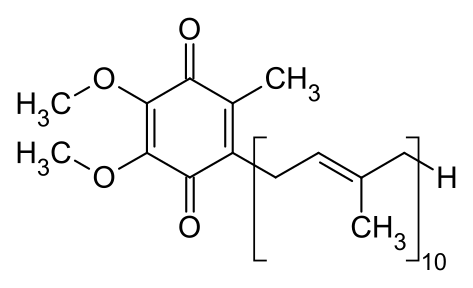
Recent studies highlight the significant benefits of Coenzyme Q10 (CoQ10) supplementation on various health markers, particularly in physical performance, cardiovascular health, and anti-aging effects. CoQ10 has been shown to significantly reduce exercise-induced muscle damage markers and oxidative stress, improving muscle performance and recovery in athletes and non-elite individuals (Clin Nutr ESPEN. 2024, Antioxidants (Basel). 2023). It also positively impacts endothelial function, increasing Flow Mediated Dilation (FMD), which indicates better vascular health (High Blood Press Cardiovasc Prev. 2024).
Additionally, CoQ10 combined with selenium has demonstrated anti-aging effects by improving biomarkers related to inflammation, endothelial dysfunction, and fibrosis in elderly populations (Cells. 2023). In subjects with dyslipidemia, ubiquinol (the reduced form of CoQ10) significantly improved endothelial function and nitric oxide bioavailability, further supporting its cardiovascular benefits (Nutrients. 2020). Moreover, CoQ10 supplementation has been found to enhance peak power production in athletes, suggesting its potential to boost athletic performance (J Int Soc Sports Nutr. 2013). These findings underscore CoQ10’s multifaceted benefits, warranting further research to solidify its role in health and disease management.
Which form of CoQ10 is better?
| Feature | Ubiquinone (CoQ10) | Ubiquinol (CoQ10H2) |
|---|---|---|
| Form | Oxidized form of CoQ10 | Reduced form of CoQ10 |
| Bioavailability | Lower bioavailability | Higher bioavailability |
| Stability | More stable | Less stable |
| Absorption | Requires conversion to ubiquinol for absorption | Directly absorbed in the body |
| Conversion | Must be converted to ubiquinol in the body to be effective | Does not require conversion, readily available for cellular use |
| Population | Suitable for general use | Often recommended for older adults or individuals with specific health conditions |
| Cost | Generally less expensive | Typically more expensive due to better bioavailability and effectiveness |
PUBLICATIONS
New
Practical Nutritional Strategies to Attenuate Physiological Stress in Adolescent Soccer Players: A Comparative Trial of CoQ10 and Taurine.
Nutrients. 2026 Jul 09;18(14):2229.
Design: Twenty-four adolescent male soccer players were randomized to placebo, coenzyme Q10 at 300 mg a day, or taurine for 14 days around three simulated matches.
Summary: In adolescent soccer players, 14 days of CoQ10 was superior for MDA, LDH, cortisol, and the testosterone:cortisol ratio. CoQ10 lowered IL-6 more than taurine, taurine raised IL-10 more, and both preserved CD4 counts, the CD4/CD8 ratio, IgA, and IgG versus placebo.
The effects of coenzyme Q10 supplementation on biomarkers of exercise-induced muscle damage, physical performance, and oxidative stress: A GRADE-assessed systematic review and dose-response meta-analysis of randomized controlled trials.
Clin Nutr ESPEN. 2024 Apr;60:122-134.
Design: Systematic review and meta-analysis of RCTs assessing CoQ10’s effects on exercise-induced muscle damage, performance, and oxidative stress.
Summary: CoQ10 significantly reduced creatine kinase, lactate dehydrogenase, myoglobin, and malondialdehyde levels, indicating reduced muscle damage and oxidative stress. No significant effect on total antioxidant capacity was observed.
Effect of Coenzyme Q10 Supplementation on Vascular Endothelial Function: A Systematic Review and Meta-Analysis of Randomized Controlled Trials.
High Blood Press Cardiovasc Prev. 2024 Mar;31(2):113-126.
Design: Systematic review and meta-analysis of RCTs evaluating CoQ10’s effects on endothelial function.
Summary: CoQ10 supplementation significantly increased Flow Mediated Dilation (FMD), indicating improved vascular endothelial function, but had no effect on VCAM or ICAM levels.
Effects of an Intervention with Selenium and Coenzyme Q(10) on Five Selected Age-Related Biomarkers in Elderly Swedes Low in Selenium: Results That Point to an Anti-Ageing Effect-A Sub-Analysis of a Previous Prospective Double-Blind Placebo-Controlled Randomised Clinical Trial.
Cells. 2023 Jul 4;12(13):1773.
Design: Sub-analysis of a double-blind placebo-controlled RCT investigating selenium and CoQ10 effects on age-related biomarkers in elderly Swedes.
Summary: Selenium and CoQ10 supplementation significantly improved biomarkers related to inflammation, endothelial dysfunction, and fibrosis, suggesting an anti-aging effect.
Ubiquinol Short-Term Supplementation Prior to Strenuous Exercise Improves Physical Performance and Diminishes Muscle Damage.
Antioxidants (Basel). 2023 May 31;12(6):1193.
Design: Randomized, placebo-controlled study evaluating the effects of short-term ubiquinol supplementation on physical performance and muscle damage in non-elite athletes.
Summary: Ubiquinol supplementation significantly improved muscle performance and reduced muscle damage markers after strenuous exercise.
Ubiquinol Ameliorates Endothelial Dysfunction in Subjects with Mild-to-Moderate Dyslipidemia: A Randomized Clinical Trial.
Nutrients. 2020 Apr 15;12(4):1098.
Design: Randomized, double-blind clinical trial assessing ubiquinol’s effects on endothelial dysfunction in subjects with mild-to-moderate dyslipidemia.
Summary: Ubiquinol supplementation significantly improved endothelial function and increased nitric oxide bioavailability, indicating potential cardiovascular benefits.
Beneficial Effect of Ubiquinol on Hematological and Inflammatory Signaling during Exercise.
Nutrients. 2020 Feb 6;12(2):424.
Design: Randomized, placebo-controlled study evaluating the effects of short-term ubiquinol supplementation on inflammatory signaling and hematological parameters during strenuous exercise.
Summary: Ubiquinol supplementation reduced pro-inflammatory cytokines and increased anti-inflammatory cytokines, suggesting a protective effect during high-intensity exercise.
Effect of ubiquinol supplementation on biochemical and oxidative stress indexes after intense exercise in young athletes.
Redox Rep. 2018 Dec;23(1):136-145.
Design: Double-blind, cross-over study assessing ubiquinol’s effects on biochemical and oxidative stress markers after intense exercise in young athletes.
Summary: Ubiquinol supplementation prevented exercise-induced CoQ depletion and reduced oxidative stress, although it did not improve physical performance markers.
Ubiquinol supplementation enhances peak power production in trained athletes: a double-blind, placebo controlled study.
J Int Soc Sports Nutr. 2013 Apr 29;10:24.
Design: Double-blind, placebo-controlled study evaluating ubiquinol supplementation’s effects on peak power output in trained athletes.
Summary: Ubiquinol supplementation significantly enhanced peak power production compared to placebo, indicating its potential to improve athletic performance.